
The problem with grout
Grout-free shower walls
Almost every shower panel on the market is sold as grout-free, and almost all of them are telling the truth. It's a low bar — panels are large, so there's nothing to grout. What matters more is what the panel's made of. That's what decides how the wall looks in ten years.
Why grout is the part that fails
Tile itself is durable — fired porcelain holds up fine against water. What fails in a tiled shower is the grid of cement joints between the tiles, and the waterproofing built behind them in the field.
- A porous joint in the wettest room in the house
- Staining that cleaning doesn't fully reverse
- Resealing on a schedule, for the life of the wall
- The most common failure point in a tiled shower
Grout is porous. It absorbs, stains, and needs sealing again on a schedule most people forget. A grout-free wall gets rid of that job entirely.
Grout-free is the easy part
Any large panel is grout-free by definition — molded acrylic, PVC, high-pressure laminate over a composite core, a polyester-resin body finished with a gel coat. The claim is true across the board, which means it doesn't tell you which one to buy.
What differs is the surface you're left cleaning. A plastic or gel-coated surface is a coating over a softer body — it scratches and dulls under abrasive cleaning. Touchstone™ is real 6mm vitrified porcelain, the same material class as premium porcelain tile, bonded to an engineered waterproof backer. It's non-porous and hard, with no coating to wear through.
Where the water goes instead
Taking out the grout only helps if something else handles the water. In a tiled shower, that job falls to a membrane built on site — the other thing that fails. In a Touchstone surround, it's engineered into the kit.
Pan skirts run across the bottom, seam skirts along the horizontal joint. Self-adhesive flashing covers the inside corners and the pan-to-wall joint. Color-matched silicone finishes every vertical corner, the horizontal seam, and the perimeter. No thinset, no full-wall membrane — the skirts and flashing carry the water path.
The silicone is still a maintenance item — it gets replaced over the life of the wall, same as every panel system in this category. It goes far longer between attention than grout does, and there is far less of it: corners, one horizontal seam, and the perimeter, instead of a grid running across every tile.
What it looks like
Far fewer joints, and none of them grout
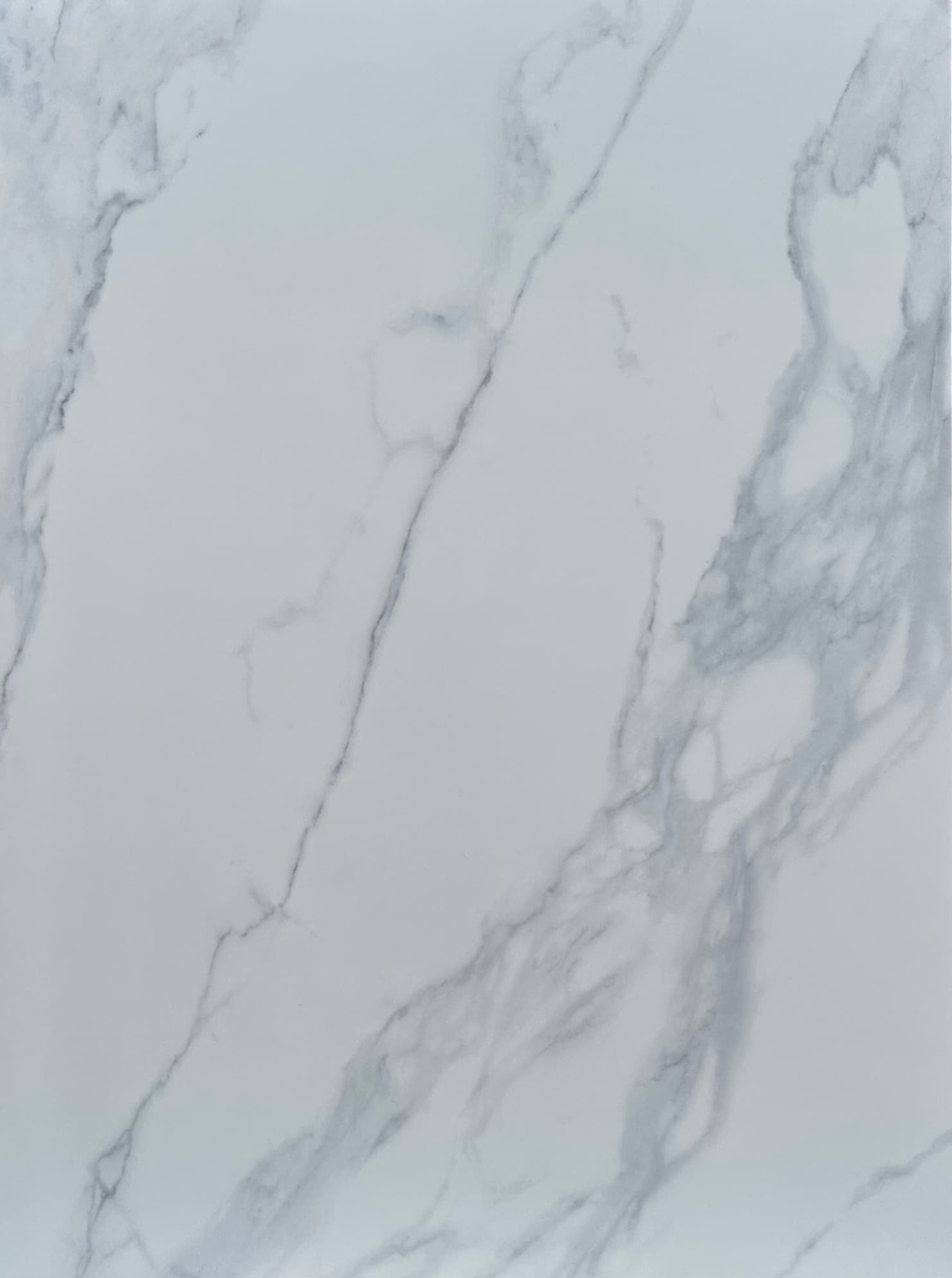
Without a joint grid running through it, a large-format panel reads as one surface. Five designs, all real porcelain, all stocked.
Common questions
That the wall has no cement grout joints in it. Nearly every panel system can claim that — panels are large enough to cover a wall in a few pieces. What the claim doesn't tell you is what the panel's made of, and that's what decides how the wall ages.
It's built into the system, not a field-applied membrane. Pan skirts run across the bottom, seam skirts along the horizontal joint, self-adhesive flashing at the inside corners and the pan-to-wall joint. Color-matched silicone finishes every vertical corner, the horizontal seam, and the perimeter.
No. There's no grout to reseal, so that recurring job is gone. But the silicone joints are still a maintenance item — they get replaced over the life of the wall. That's true of every panel system in the category, ours included.
Grout is porous, and a porous joint in a wet room is somewhere for mold to sit. Take out the grout and that joint's gone. The porcelain face itself is non-porous too, so there's no absorbent surface for anything to get into.
No. Most grout-free panels are plastic or resin — molded acrylic, PVC, high-pressure laminate over a composite core, or a polyester-resin body under a gel coat. Touchstone is real 6mm vitrified porcelain, the same material class as premium porcelain tile. They're all grout-free. They don't wear the same.
Real porcelain carries a stone pattern fired into a vitrified surface, in large-format panels with no joint grid interrupting it. See the Touchstone designs to judge it yourself.