
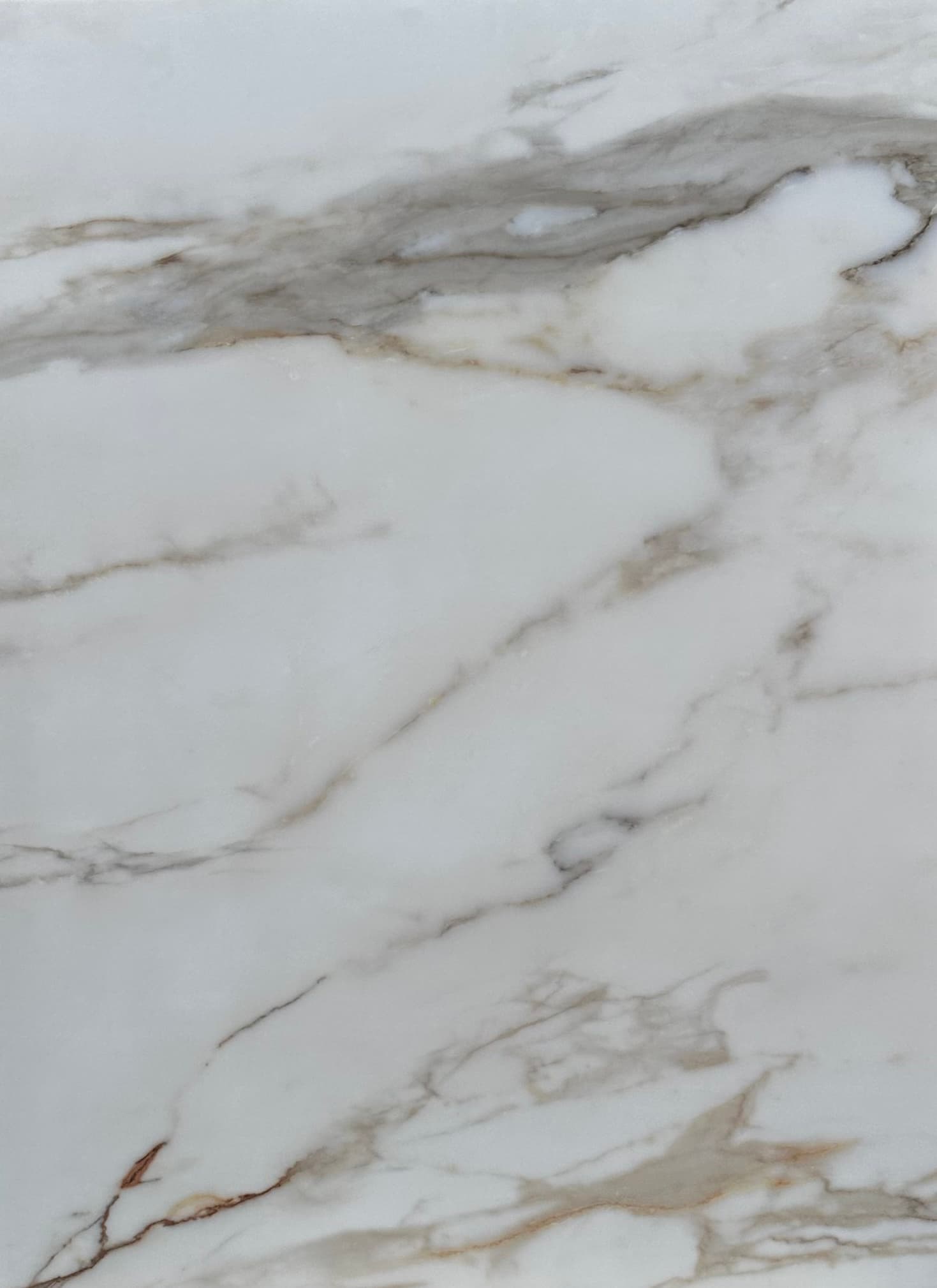
Compare
Porcelain wall panels vs. cultured marble
Touchstone™ has a real fired-porcelain face. Cultured marble is a cast polymer — crushed stone suspended in polyester resin, cast in a mold, and finished with a gel coat that forms the visible surface. Both give you a grout-free wall that installs without wet trades. The difference is the surface you end up living with: vitrified ceramic on one, a pigmented resin coating on the other.
Side by side
| Touchstone | Cultured marble | |
|---|---|---|
| Material | Real 6mm porcelain | Crushed stone in polyester resin, cast in a mold |
| Surface | Fired ceramic, hard and heat-resistant | Gel coat — a pigmented resin wear layer |
| Look | Real stone-look porcelain | Veining cast into the body, under a gloss gel coat |
| Wear | Resists scratching | Gel coat can scratch and dull; buffing restores it |
| Seams | Color-matched silicone at the joints | Caulked joints, or cast in one piece |
| Install time | One day | One to two days |
Who makes it
Brands in this category include The Onyx Collection and Mincey Marble.
Where Touchstone wins
- A real fired-porcelain face, not a gel-coated resin body
- Vitrified ceramic — harder and more heat- and scratch-resistant than a gel coat
- Factory-consistent panels on an engineered track system
The one tradeoff
Cultured marble is cast to order, so it can be molded into shapes a panel kit doesn't cover — integral pans, cast-in shelves and seats, and one-piece runs for an unusual opening. That flexibility comes in a cast resin body with a gel-coat surface, not porcelain.
Common questions
Cultured marble is a cast polymer: crushed limestone or marble particulate mixed into polyester resin, poured into a mold, and finished with a gel coat. The gel coat is the surface you see and touch. It is not quarried stone, and it is not fired ceramic.
On the surface itself, Touchstone is a hard, vitrified fired ceramic rather than a pigmented resin gel coat, so it resists scratching and heat better. Cultured marble's advantage is casting flexibility — integral pans, cast-in shelves, and shapes made to order.
The gel coat is the wear layer, and it can scratch or lose its gloss over time, particularly with abrasive cleaners. It can usually be buffed and re-polished, which is a genuine advantage — but the damage happens to a coating, where Touchstone's porcelain face resists it in the first place.
No, though they are often confused. Solid surface is an acrylic-and-mineral composite that is the same material through its full thickness, which is why scratches can be sanded out. Cultured marble is a polyester-resin body finished with a gel coat, so the surface is a coating over the body rather than the body itself.
The system
See the Touchstone porcelain wall panel system.
Real 6mm porcelain on a patented mechanical track. A full shower surround installs in a day, with no thinset, grout, or wet trades.